QR codes have had an unusual journey.
They were created back in 1994 for tracking car parts, had a brief moment of hype in the early smartphone years, then largely faded away. For a long time, they felt like a technology that never quite stuck.
Then something changed.
During the pandemic, scanning a QR code became second nature. People used them for menus, check-ins, payments, tickets. What had once needed explaining suddenly became instinctive. By the time live events returned, the behaviour was already there.
That shift has had a major impact on how audiences interact inside venues.
Why QR Works in Stadium Environments
Live events are a difficult environment for technology. Large crowds, limited connectivity, short attention spans. QR codes happen to solve several of these problems at once.
No App Download
The biggest advantage is what QR removes from the process.
Getting tens of thousands of people to download an app at the same time simply does not work in a stadium setting. Even aiming for a fraction of the crowd can overload networks and create a poor experience.
QR codes avoid this entirely. A fan scans, their browser opens, and they are in. No install, no setup, no friction.
Works on Every Phone
QR codes are as close as you get to a universal standard.
It does not matter what device someone has or how up to date it is. If they can open their camera, they can take part. That consistency is critical when you are trying to engage an entire crowd, not just a portion of it.
The difference between partial participation and mass participation is huge. When most of the stadium is involved, the atmosphere changes completely.
Fast Enough for Live Moments
Speed matters more than anything in a live setting.
If it takes too long to get involved, the moment is gone. Fans move on, attention shifts, and the opportunity disappears.
A well-optimised QR flow should take seconds, not minutes. Scan, load, interact. That simplicity is what allows it to work in real time, during breaks in play or short windows of attention.
Getting the QR in Front of People
The technology itself is simple. The real challenge is making sure people actually see it.
In a large venue, that requires planning.
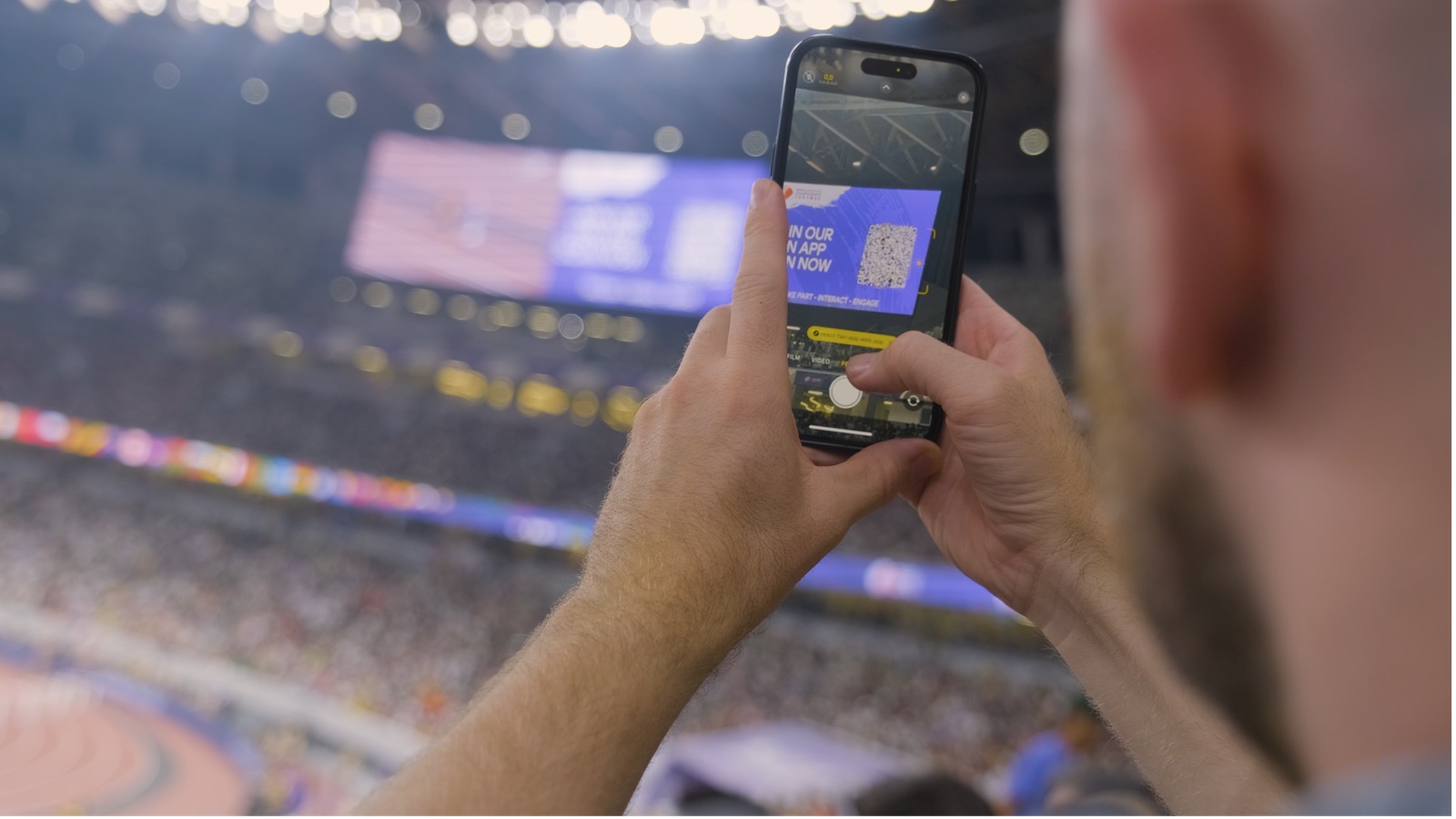
Displaying QR codes on big screens and LED boards gives you reach across the entire stadium. Rotating them regularly helps capture fans arriving at different times.
Printed placements add consistency. Tickets, seat cards and programmes mean the code is always available, even when screens are not in view.
On top of that, staff on the ground can make a big difference. A small team helping fans scan early in the event can significantly increase overall participation.
Where the code appears, and when, has a direct impact on engagement levels.
More Than Just Access
QR codes are not only a way to get fans into an experience. They also create a useful layer of data.
Different codes in different parts of a venue can show where engagement is strongest. You can start to see patterns in how fans move, where they interact, and which moments drive the most participation.
That information is valuable beyond a single event. It helps shape future activations, improves sponsor placements, and gives organisers a clearer picture of how their audience behaves.
Where QR Falls Short
QR is not perfect.
Low lighting can make scanning harder, particularly before lights come up at concerts. Not every device performs equally well. And, importantly, scanning still requires a decision from the fan.
That last point is the most important.
A QR code is only an entry point. If there is no clear reason to scan, most people will ignore it. The experience behind it has to be immediate and obvious.
"Scan to join the light show" works. "Scan for more information" does not.
Final Thought
QR codes are not flashy technology, but they have become one of the most reliable tools in live events.
They provide something that is surprisingly difficult to achieve at scale. Easy access, minimal friction, and instant participation across an entire crowd.
In many ways, they have become invisible infrastructure. Fans do not think about them, they just use them. And that is exactly why they work.
Want to understand how QR-based fan engagement could work at your event? Speak to the React team.